

EMOMASTERS® Math Magic Library
A calmer, more human way to learn math — without replacing your curriculum
The Moment Math Clicks
JOYFULLY, here's what students do when Brain-Ready Classrooms flourish.
What This Is
The EMOMASTERS® Math Magic Library is a curated collection of brain-based, movement-informed math learning experiences designed for students in grades 5–8 who have not consistently responded to traditional instruction.
It is not a curriculum replacement.
It is a flexible experience library that strengthens understanding, engagement, and confidence alongside any existing math program.
Schools use it to:
- reduce math anxiety
- increase student participation (engagement)
- deepen conceptual understanding
- support diverse learners without tracking or remediation labels
Why This Exists
Many students don’t struggle with math because they lack ability — they struggle because their nervous systems are overloaded, their confidence has been eroded, or instruction has never connected to how their brains actually learn.
The Math Magic Library was designed to address the hidden barriers to math learning:
- fear of being wrong
- cognitive overload
- passive learning formats
- disconnection between concepts and meaning
By integrating movement, pattern recognition, sound, reflection, and choice, the library helps students feel safe, capable, and connected — which is when learning becomes possible.
The Math Magic Concept Lab Framework
At the heart of the library are Concept Labs — short, focused experiences that help students feel mathematical ideas before formalizing them.
Concept Labs:
- make abstract ideas visible and tangible
- emphasize relationships, not memorization
- allow students to enter at different points
- support mastery without pressure
Each Concept Lab targets one core mathematical idea, using movement, pattern, sound, or visual structure to build understanding and math confidence that lasts.
📄 A full Concept Lab overview is available for download below.
How the Math Magic Library Works
The library is intentionally designed to be:
- non-linear (teachers choose what fits)
- student-safe (no forced pacing or public performance)
- easy to integrate (no special materials required)
Key features include:
- Domain-coded experiences aligned to core math concepts
- Short labs that fit into existing lessons or stand alone
- Built-in reflection through the Math Return Journal (N.E.X.T.)
- Clear teacher guides and mini-maps for planning
Students can return to experiences multiple times, building confidence through familiarity rather than pressure.
Who This Is For
The Math Magic Library supports:
- general education classrooms
- intervention and enrichment settings
- inclusion and co-taught classrooms
- alternative, homeschool, and microschool environments
It is especially effective for:
- students with math anxiety
- students who disengage during traditional instruction
- students who need movement or sensory input to focus
- teachers seeking flexible, humane instructional tools
Information for Schools & Districts
The Math Magic Library:
- aligns with existing standards and curriculum frameworks
- requires no changes to pacing guides or adopted materials
- supports MTSS, UDL, and competency-based approaches
- can be implemented classroom-by-classroom or schoolwide
Schools typically use the library as:
- a classroom engagement tool
- a conceptual reinforcement resource
- a bridge between instruction and assessment
- a professional learning model for teachers
📄 A printable overview for schools, districts, and funders is available below.
What Happens Next
You’re invited to explore the library in a no-pressure way.
Choose what makes sense for you:
- ▶️ Explore sample experiences
- 📄 Download the school & district overview
- 🧠 Learn more about the Concept Lab framework
- 💬 Request a conversation about implementation
This library was built to support teachers, honor students, and expand what’s possible in math learning.
-
📞 Request a demo or pilot conversation
Math Magic Library | Brain-Based Math for Grades 5–8
👉 Explore our EMOMASTERS® Math Magic Library
(Scalable for Grades 2-9)
When Math Starts to Make Sense
Something unusual happens when students experience math through patterns instead of pressure.
Instead of avoiding participation, they begin asking to go next.
What You're About to See (Below)
You're about to watch something subtle.
Not a game.
Not a trick.
Not a reward system.
Structure.
Pattern.
Movement.
Permission to feel capable.
And then something shifts.
A student says:
“I'm a baller.”
Another jumps up.
Another asks,
“Can I do one?”
“Can I go next?”
“After her?”
“After him?”
When is the last time you saw students beg to solve fractions?
This is not hype.
This is what happens when:
The nervous system feels safe
AND
The brain sees pattern.
JOY before rigor.
What Just Happened?
Nobody was bribed.
Nobody was pressured.
Nobody was shamed.
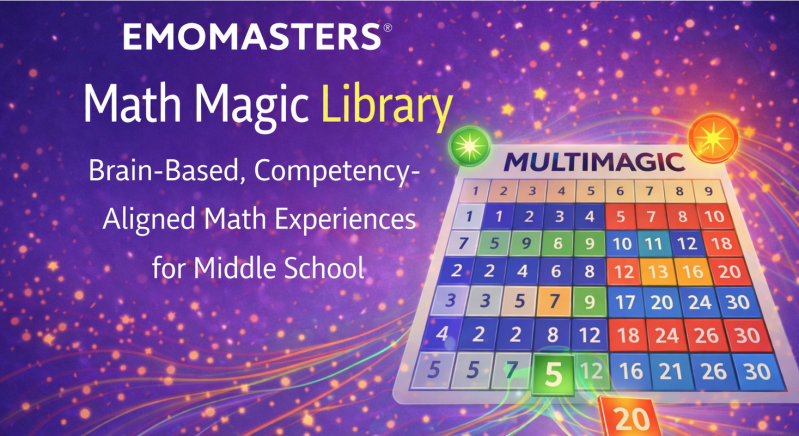
The Multimagic Table creates visible structure.
Structure lowers threat.
Lower threat restores access.
Access builds confidence.
Confidence invites rigor.
Students stop avoiding challenge.
They start chasing it.
The Real Question
If students felt this way every time they approached math —
What would change?
How much time would you get back?
How much resistance would dissolve?
How many identities would shift?
Here's the Truth
Most math programs try to add engagement.
Math Magic rebuilds math identity.
That requires more than one activity.
It requires:
Structure
Sequencing
Repetition
Pattern immersion
System
If this preview already feels different,
that’s because it is.
This is what happens when math finally makes sense.
For Families and Homeschool Parents
You don’t need to be a math expert to use this system.
The Math Magic Library was designed so that students discover patterns visually, instead of relying on memorization alone.
Many parents tell me something surprising happens when they begin using these experiences at home:
Children who once avoided math begin to lean in.
Not because someone pushed them.
Because they can finally see how math works.
The library includes guided experiences that help students explore:
• patterns
• multiplication structure
• fractions
• mathematical relationships
All through movement, visual structure, and discovery.
The goal is simple:
Help students feel capable before pressure appears.
When that happens, learning changes.
Students are SELF-Teaching!
Students begin self-teaching quickly.
With the MULTIMAGIC Table as an anchor, students independently verify answers, spot patterns, and support peers.